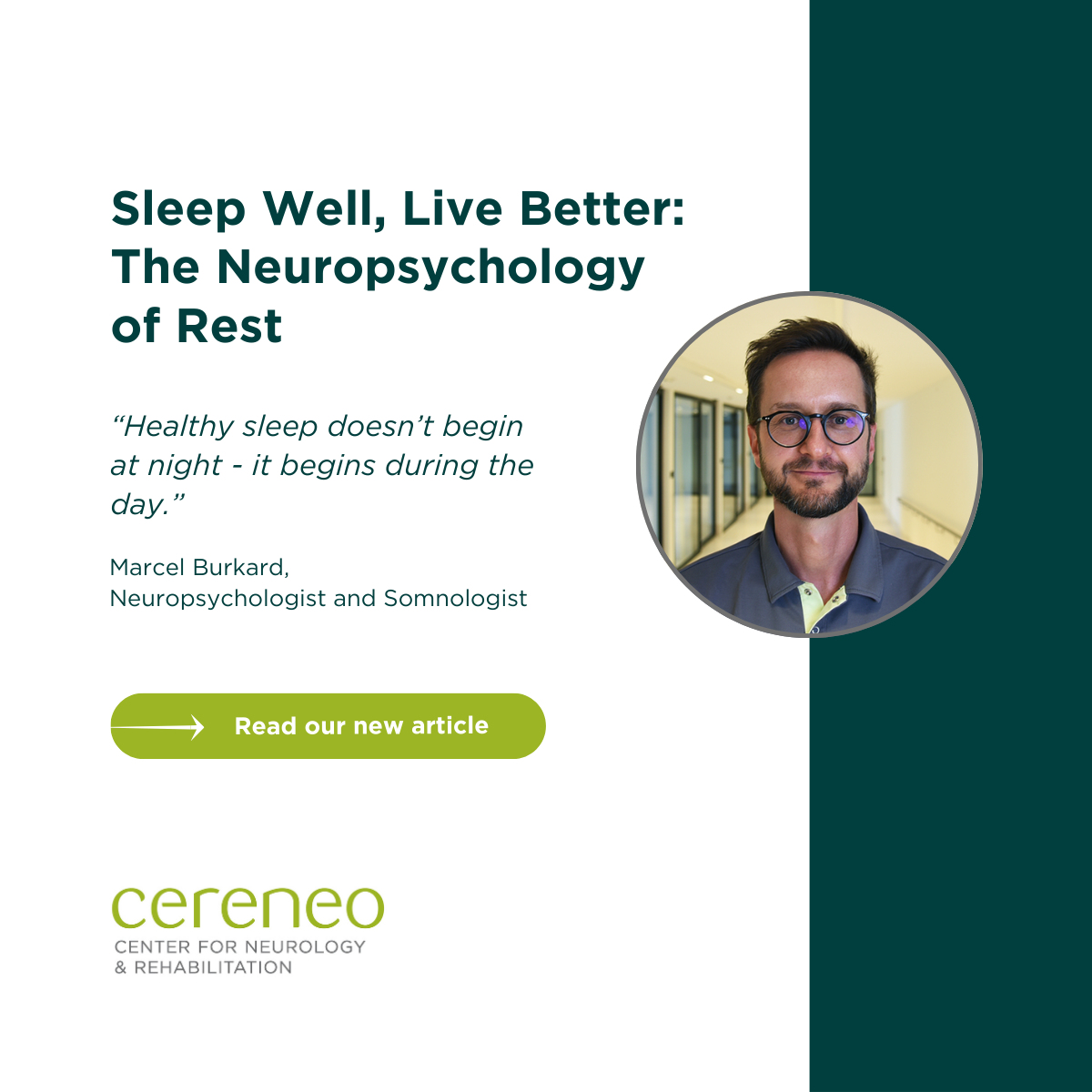

In celebration of World Sleep Day, we explore this year’s theme: “Sleep Well, Live Better.” At cereneo, we understand that sleep isn’t just a period of inactivity; it is a sophisticated neurological process essential for recovery, cognitive function, and emotional resilience.
To learn more about the science of sleep, we spoke with our neuropsychologist and somnologist, Marcel, to discuss how we can optimize our days to make our nights more restful.
It’s a vital question because sleep is the foundation of our waking performance. When we look at sleep through a clinical lens, we focus on three “golden ingredients”: sufficient duration, high quality, and consistent timing.
However, the most important shift in perspective is this: Healthy sleep doesn’t actually begin at night, it begins the moment you wake up.
To stabilize your internal clock and promote deep, restorative rest, sleep medicine points to a few evidence-based pillars that anyone can implement:
It is a common misconception that sleep issues are just “side effects” of a neurological condition. In reality, they are often a core part of the condition itself. Whether it is a stroke, Parkinson’s, or a traumatic brain injury (TBI), the brain’s ability to regulate sleep is frequently disrupted.
We typically see five primary challenges in our patients:
Insomnia: Difficulty falling or staying asleep, often fueled by changes in brain chemistry, hospital routines, or the emotional weight of recovery.
Disrupted Sleep-Wake Cycles: Damage to the brain’s internal clock (the SCN) can cause patients to nap excessively during the day, which unfortunately sabotages their rest at night.
Breathing Disorders: Conditions like sleep apnea are remarkably frequent after a stroke. If left untreated, these can impair cognitive recovery and increase cardiovascular risk.
Restless Limbs: Involuntary movements can prevent a patient from reaching a relaxed state, leading to fragmented sleep that the patient might not even be fully aware of.
Excessive Daytime Sleepiness: This is often a complex mix of the brain injury itself, medication effects, and poor nighttime quality.
We treat sleep as a pillar of neurorehabilitation, not an afterthought. Our approach is systematic.
It begins with a careful screening process where we use targeted questionnaires and precise measurements, such as pulsoximetry, to identify any immediate red flags. When these initial findings suggest a deeper issue, we move toward a more “high definition” look at the night through polysomnography. This allows us to see exactly what the brain and body are doing while the patient is asleep.
Once we have that data, our intervention is twofold. We use Cognitive Behavioral Therapy (CBT) to help patients reshape dysfunctional thinking patterns and attitudes that may be “destroying” in their sleep. Simultaneously, we work on the physical side by optimizing their resting environment to ensure it actively promotes recovery.
We see the life-changing impact of this integrated care every day. I recall a specific case where a stroke patient believed he was “sleeping all night,” yet he remained utterly exhausted during his daytime therapy sessions. After we conducted a sleep study, we discovered he was suffering from severe sleep apnea. Once he began CPAP therapy, his alertness didn’t just improve – it transformed. He suddenly had the physical and mental energy required to fully engage with his rehabilitation training.
We need to align sleep schedules to allow for maximum participation in rehabilitation during the day, but we also recognize that recommendations must be realistic and culturally sensitive. Shifting the sleep-wake rhythms a patient has developed over a lifetime takes time. We use tools like melatonin and therapy lamps to help advance or delay these rhythms, but we always ground our approach in three fundamental questions:
We aren’t looking for perfection; we are looking for stability. For instance, I worked with a patient who insisted on watching the late-night news because it had been his lifelong habit. Rather than prohibiting it – which likely would have failed – we adjusted the screen brightness, shifted his wake-up time slightly, and optimized his light exposure the following morning.
Technology is a powerful ally in our clinical toolkit, but it must be used with intention. Data without expert interpretation is often misleading. A German study even highlighted that these devices have only a moderate ability to detect sleep disorders and frequently trigger “false alarms”. At cereneo, we advise our patients to view technology as a guide, not a judge. It cannot replace the behavioral consistency that forms the foundation of good rest.
That phrasing is spot on. In our daily clinical practice, we see that the most powerful lesson about sleep is consistency. One of the hardest things for patients to learn is that “trying harder” to sleep usually makes it worse. Instead, building a stable daily rhythm is what actually brings sleep.
We focus on a few key habits that have a massive real-world impact. This starts with getting natural or therapy light within 30 minutes of waking and maintaining a consistent wake-up time, even after a poor night’s sleep. During the day, we encourage patients to avoid heavy evening meals and late caffeine, and while naps are often needed in neurorehabilitation, we try to keep them under 30 minutes to avoid sabotaging the night.
We repeatedly observe that as sleep improves, a patient’s mood stabilizes, their attention sharpens, and their memory begins to consolidate. Their physical endurance and motivation rise because sleep is not passive downtime – it is active brain recovery. Especially after a neurological injury, sleep becomes therapeutic, providing the brain with the biological conditions it needs to reorganize, heal, and adapt.
At cereneo, we see sleep as a vital partner in the journey toward independence and health. Whether you are recovering from a neurological event or simply looking to enhance your daily wellbeing.